
A UK haulage company has had its operator’s licence permanently revoked, and its sole director personally disqualified from the industry for 12 months, after a Traffic Commissioner found he knowingly continued running vehicles for three weeks after his licence had already been revoked.
The Deputy Traffic Commissioner for the North East of England, Gerallt Evans, published the decision on 8 October 2025 following a public inquiry held in Leeds. The case involved BTW Transport Ltd, a seven-vehicle haulage operator, and its director, Byron Thomas Williams.
Key outcomes:
- BTW Transport Ltd’s operator’s licence revoked, effective 22 October 2025
- Company disqualified from holding any operator’s licence for 12 months
- Director Byron Williams personally disqualified from holding or being involved in any operator’s licence, and from directing any company that holds one, for 12 months
- Former transport manager Nichola Ogilvie found to have lost her good repute, disqualified from acting as a transport manager until further order
- No financial fine was imposed; these are regulatory sanctions, not monetary penalties
What Happened: The Full Timeline
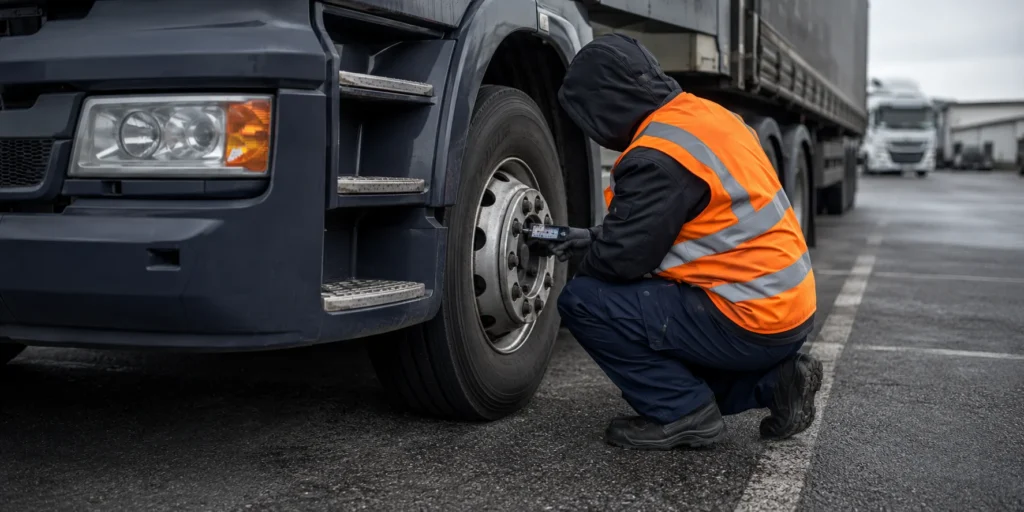
January 2024 — A routine annual test found one of the company’s vehicles had loose wheel nuts, resulting in an immediate prohibition notice.
March 2024 — A DVSA maintenance investigation found the company’s inspection records were poorly completed and sometimes referenced parts that were not actually fitted to the vehicles. There was no proper evidence of brake testing, and the driver defect-reporting system was not working effectively.
April 2024 — A further DVSA check found a vehicle being operated without valid road tax, which had expired five months earlier. This gave the company an unfair commercial advantage over compliant competitors.
September 2024 — Transport manager Nichola Ogilvie resigned, citing the company’s failure to respect her position and concerns over its financial standing. Without a transport manager in place, the company temporarily lost the professional competence required to hold a licence.
6 November 2024 — The Traffic Commissioner directed that the licence be revoked due to the loss of professional competence.
November 2024, for roughly three weeks — Despite knowing the licence had been revoked and that he had no legal authority to operate, Williams continued running the company’s vehicles. This was confirmed through automatic number plate recognition (ANPR) data showing the vehicles on public roads during this period.
25 November 2024 — The licence was reinstated while the company appealed, with conditions attached relating to professional competence and financial standing.
July and September 2025 — A public inquiry was held in Leeds over two sessions to examine the full pattern of compliance failures, including the unauthorised operating period, the maintenance issues, and concerns about the reliability of evidence presented by the operator.
8 October 2025 — The Deputy Traffic Commissioner published the decision: licence revoked, company and director disqualified for 12 months, former transport manager’s good repute found lost.
It’s also worth noting this was not the company’s first regulatory brush. A 2022 public inquiry had already resulted in a licence curtailment and formal warning, following a similar wheel nut prohibition the year before. The Commissioner noted that the company had failed to heed that earlier warning.
Why the Penalty Was So Severe
Traffic Commissioners weigh up positive and negative factors before deciding on regulatory action. In this case, the negative factors were considered to outweigh the positive ones by a wide margin. The decision specifically pointed to several aggravating issues:
- Deliberate unauthorised operation. Continuing to use vehicles for three weeks after a known licence revocation was treated as the most serious factor in the case, shifting the matter from the “serious” to the “severe” category under the Commissioner’s sentencing-style guidance.
- A high prohibition rate. At 42%, the company’s prohibition rate was nearly double the national average, and prohibitions continued to be issued even while the public inquiry was ongoing.
- Unreliable evidence. The Commissioner found parts of Williams’s written and oral evidence to be misleading, including a claim about a supplier dispute that did not match the documentary record.
- Repeated failure to comply with directions. Despite being given an adjournment and clear instructions to produce evidence, the operator repeatedly failed to fully comply ahead of the resumed hearing.
- A prior warning ignored. The 2022 public inquiry outcome should have served as a clear signal, but the same underlying problems resurfaced.
The Commissioner did not rule out Williams applying for a new licence in the future, but said any future application would need to be backed by clear evidence that he understands what compliance requires and has genuine support in place to deliver it.
The Solution: How UK Operators Can Avoid the Same Outcome
This case is a useful, if costly, lesson for any UK haulage operator. Based on exactly what went wrong here, there are five practical steps that meaningfully reduce the risk of a similar outcome.
1. Treat maintenance records as evidence, not paperwork. Inspection sheets need to reflect what was actually done to the vehicle, including accurate brake test results. Records that don’t match reality are treated by regulators as a sign the whole compliance system can’t be trusted, even before any accident happens.
2. Give your transport manager real authority. A transport manager named on a licence needs genuine access to systems, drivers, and finances, and a direct, accountable relationship with the operator. Appointing someone without giving them the tools or support to do the job creates exactly the kind of gap regulators look for.
3. Never operate after a licence is revoked, even mid-appeal. If a licence is revoked and you believe the decision is wrong, the correct route is a formal appeal with a stay request, not continuing to run vehicles in the meantime. As this case shows, doing so turns a recoverable situation into a business-ending one.
4. Act immediately on DVSA findings. When an investigation flags problems, the fix needs to happen straight away, not get revisited later. Commissioners look closely at whether previous recommendations were actually implemented, not just promised.
5. Keep the Traffic Commissioner informed of material changes. Financial difficulties, legal disputes such as a winding-up petition, or a change in maintenance provider all need to be reported. Staying silent and hoping issues resolve themselves on their own tends to make things look worse, not better, if they later come to light.
FAQ
Was Byron Williams fined? No monetary fine was imposed. The Traffic Commissioner’s powers in this kind of case are regulatory, covering licence revocation and disqualification, not financial penalties.
Can BTW Transport Ltd apply for a new licence? The company is disqualified from holding or obtaining any operator’s licence until 22 October 2026. After that, a new application would be assessed on its own merits.
What does “good repute” mean in this context? It’s a legal standard operators, directors, and transport managers must meet to hold or be involved with an operator’s licence. Losing good repute, as both Williams and Ogilvie did here, generally results in disqualification.
Why wasn’t current transport manager Christopher Rouse penalised? Rouse only took up the role in January 2025, after the events under investigation had already occurred, so no adverse findings were made against him.
How long do operator licence disqualifications usually last? For a first public inquiry, periods of one to three years are typical, rising to five to ten years for more serious cases or where there’s a history of previous inquiries. This case received a 12-month disqualification.
Source: Decision for BTW Transport Ltd (OB2034896) and former transport manager Nichola Ogilvie, Traffic Commissioners for Great Britain, published 8 October 2025.
For more relevant news, visit this page: Trending news