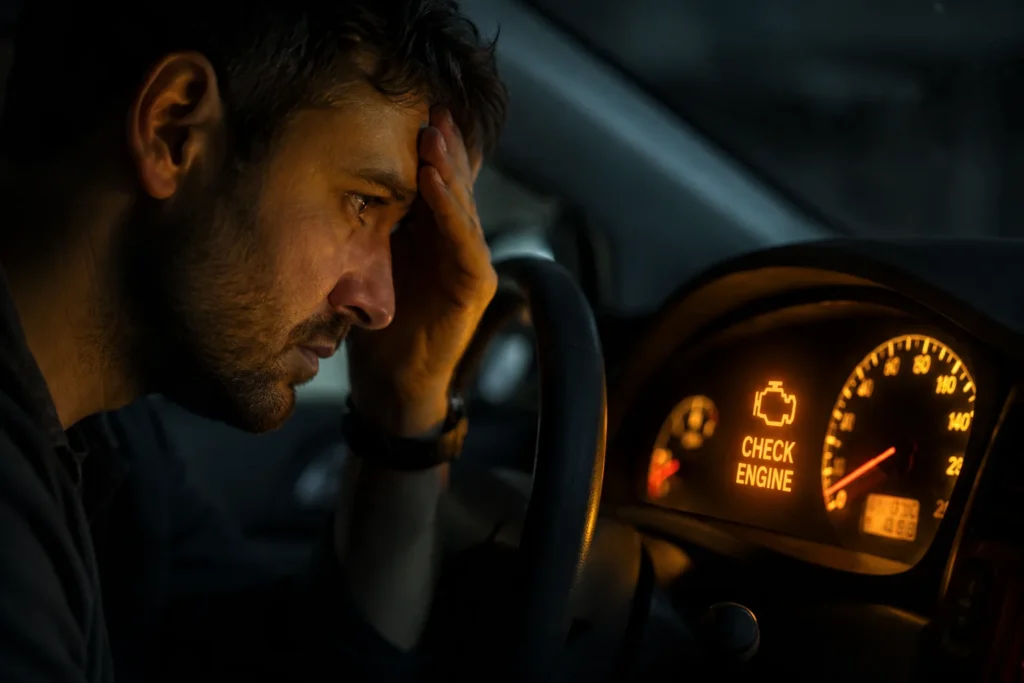

That orange glow on your dashboard is never good timing. You’ve got an inspection coming up, the check engine light is staring you down, and you’re wondering if you can just show up and hope for the best. Short answer: probably not. But the full picture is more complicated than a flat yes or no, and understanding it could save you a wasted trip, a reinspection fee, or a repair you don’t actually need yet.
Here’s what really happens when you pull into an inspection station with that light on.
What the Check Engine Light Actually Tells Inspectors
Most people think the inspector glances at your dashboard. That’s not how it works anymore.
Since 1996, every car sold in the US has been required to have an OBD-II system built in. OBD stands for On-Board Diagnostics, and it’s the computer that monitors your engine, transmission, and emissions components around the clock. When something goes wrong, the system stores a Diagnostic Trouble Code (DTC) and switches on the Malfunction Indicator Lamp, which is the official name for what most people call the check engine light.
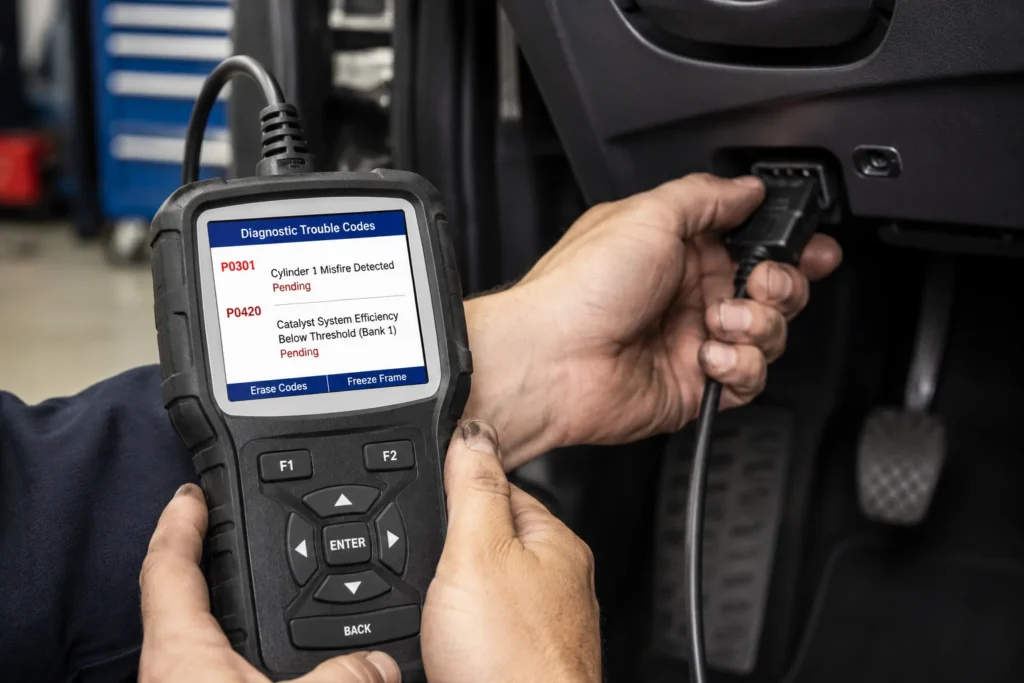
At a modern inspection station, the inspector plugs a scanner directly into a port under your dashboard. That device reads your vehicle’s computer data, not just the light on your dash. It checks three things:
- Whether the Malfunction Indicator Lamp is commanded on
- Whether any active DTCs are stored
- Whether your OBD readiness monitors have completed their self-tests
If that light is on, the computer reports it regardless of whether the bulb itself is functioning. You can’t fool the system by pulling the bulb. The failure is recorded at the data level.
Will a Lit Check Engine Light Automatically Fail an Inspection?
In most states, yes. An active Malfunction Indicator Lamp is an automatic failure for the emissions portion of an inspection.
Here’s where it gets a little more nuanced: not every state runs emissions testing. As of 2026, roughly 28 states and the District of Columbia require emissions testing in at least some areas. The other 22 states have no emissions testing requirement at all, meaning your check engine light may not affect your inspection result there.
If your state has emissions testing, a lit check engine light is almost always an automatic failure. States like California, New York, Massachusetts, New Jersey, and Colorado are strict on this. The light being on signals to the OBD system that an emissions-related fault is present, and no sticker gets issued until the underlying problem is resolved.
If your state only requires a safety inspection, the check engine light generally won’t cause a failure on its own. Safety inspections look at your brakes, tires, lights, windshield wipers, and steering components. They don’t scan your OBD system. In those states, a lit warning light may not even come up during the process.
The catch: even within states that don’t require statewide emissions testing, certain counties sometimes impose their own requirements. Always check your specific county’s rules through your state DMV, not just general state policy.

The Readiness Monitor Problem: Why Clearing Codes Won’t Save You
A lot of drivers try this: they clear the trouble codes with a cheap OBD scanner or by disconnecting the battery, the light goes off, and they drive straight to the inspection station. It seems clever. It almost never works.
Here’s why. When you reset your car’s computer, all those OBD readiness monitors go back to “not ready.” Those monitors are self-tests that the vehicle’s system runs on components like the catalytic converter, oxygen sensors, and the evaporative emissions system. Inspectors check whether those tests have been completed, not just whether the light is off.
Federal standards set the rules on how many incomplete monitors are allowed at inspection:
- Vehicles from 1996 to 2000: No more than two incomplete monitors
- 2001 and newer vehicles: No more than one incomplete monitor
Show up right after a reset with five monitors still running, and you’ll fail despite having a dark dashboard. The inspection equipment flags it as “not ready,” and you’ll need to come back.
Getting those monitors to complete requires real driving, both city and highway miles, over multiple warm-up cycles. Most vehicles need somewhere between 50 and 150 miles of mixed driving before all monitors reset to ready, though the exact number varies by make and model. Some vehicles are more stubborn than others.
What to Do Before Your Inspection
If your check engine light is on, the best move is to diagnose the problem before you do anything else.
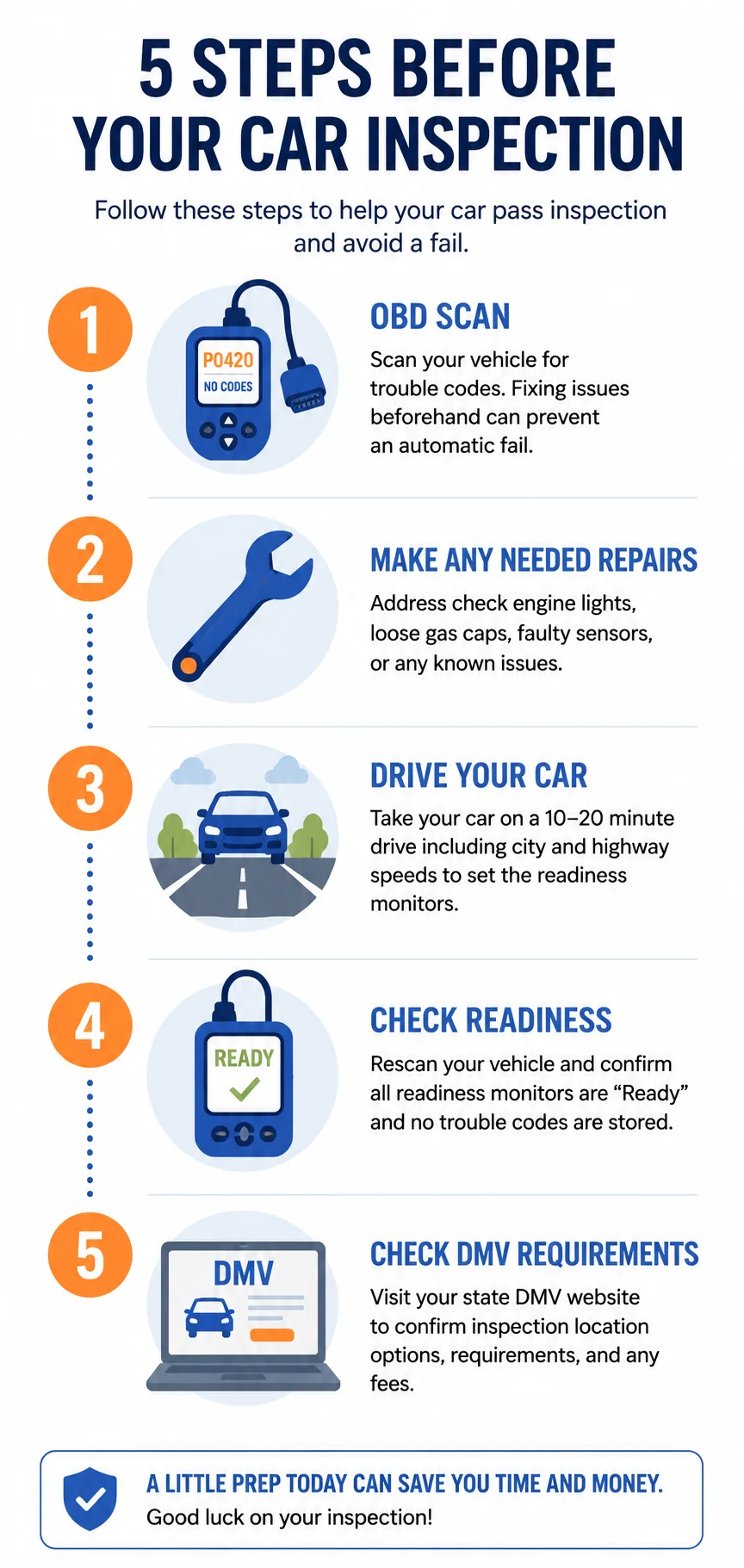
Step 1: Get a free code scan. Auto parts stores like AutoZone and O’Reilly offer free OBD-II scans. This tells you the specific trouble code, which points you toward the problem. Some issues are minor, like a loose gas cap triggering an evaporative leak code. Others indicate more significant work, like a failing catalytic converter or faulty oxygen sensor.
Step 2: Fix the problem or get an estimate. Even if you can’t afford a full repair right now, knowing the code helps you understand whether you’re looking at a $20 gas cap or a $600 sensor. Don’t skip this step.
Step 3: Complete a drive cycle. After any repair and code clearing, drive the vehicle normally for at least several days before the inspection. Mix highway and city driving to help the monitors complete their self-tests. Avoid showing up the day after a repair.
Step 4: Check monitor status before your inspection. A basic OBD-II scanner, available for under $30, lets you check whether your readiness monitors show “ready” or “not ready.” If monitors are still incomplete, keep driving.
Step 5: Know your state’s rules. If you live in one of the roughly 22 states with no emissions testing, your check engine light may not stop you from passing a safety-only inspection. Confirm this through your state’s DMV website.
FAQ: Check Engine Light and Vehicle Inspections
Q: Can I pass inspection if my check engine light just came on? A: No, not in states that require emissions testing. Even a brand-new code will cause a failure. The light being on signals an active fault to the inspection equipment, regardless of how recently it appeared.
Q: What if my check engine light is for something minor, like a loose gas cap? A: It doesn’t matter how minor the cause is. An active Malfunction Indicator Lamp is a failure point for emissions tests. Tighten or replace the gas cap, clear the code, complete a drive cycle, and then go for the inspection.
Q: Will disconnecting my battery turn off the light and help me pass? A: No. Disconnecting the battery clears the codes and resets your readiness monitors. You’ll likely fail for incomplete monitors rather than an active light. This approach does more harm than good.
Q: Are there any exemptions from failing with a check engine light on? A: Some states offer a cost waiver program for drivers who have spent a minimum amount on repairs but still can’t pass emissions. California, New York, and several other states have these programs. Requirements vary significantly, so check with your state DMV for specifics.
Q: My state doesn’t have emissions testing. Will I still fail inspection? A: In most cases, no. If your state only requires a safety inspection, the check engine light typically won’t cause a failure on its own. Confirm this with your specific county’s DMV, as some counties layer their own emissions requirements on top of state rules.
Q: How long do I need to drive after clearing codes before an inspection? A: Most vehicles need between 50 and 150 miles of mixed driving to complete all OBD readiness monitors. Check your specific monitor status with an OBD scanner before heading to the inspection station.
The Bottom Line
A lit check engine light is almost certainly a problem for your inspection if you live in one of the states with emissions testing requirements. The fix isn’t to clear the codes and hope. It’s to diagnose the actual fault, repair it properly, complete a real drive cycle, verify your monitors are ready, and then head in for the test.
Skip any of those steps, and you’re likely looking at a failed inspection, a reinspection fee, and another trip to the station. Doing it right the first time costs less time and money than taking the shortcut.