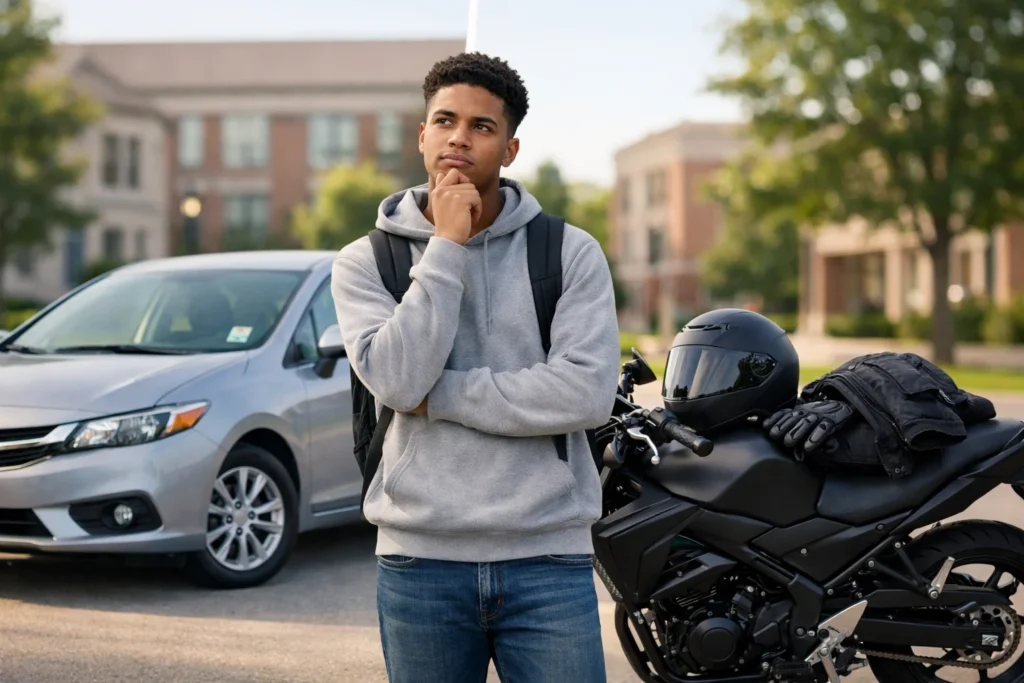

You’re sitting in class, stressed about money, and your old campus bus pass just expired. You need wheels, but your bank account is basically empty. Should you drop $8,000 on a used car or go all-in on a motorcycle for under $5,000? And honestly, which one won’t leave you stranded or broke by next semester?
The real answer: it depends on your actual life, not what some generic guide tells you.
Let’s dig into this honestly, with real numbers and no bias. Both vehicles have serious advantages and real drawbacks. Your choice comes down to what matters most to you right now.
The Quick Answer (At a Glance)
Before we get into the details, here’s what you need to know:
Choose a motorcycle if:
- Your campus is compact and you can park easily
- You live in warm weather (no snow or ice)
- You’re on a tight budget and cost is the biggest factor
- You don’t need to transport friends regularly
- You’re willing to take a motorcycle safety course
- You’re okay with being exposed to the elements
Choose a car if:
- You need to transport friends or family
- You live somewhere with bad weather
- Safety and protection matter most to you
- You want maximum comfort and convenience
- You prefer not learning a new skill set right now
- You need storage space for stuff
Still unsure? Keep reading, because the actual decision isn’t as simple as those bullet points. Your situation is specific, and the right choice depends on what’s actually important to you.
Cost Breakdown: The Money Reality
This is where most people look first, and honestly, it’s where motorcycles win decisively in the short term.
Purchase Price
A decent used car? You’re looking at $8,000 to $12,000 for something reliable. Think a 2015-2018 Honda Civic, Toyota Corolla, or Honda Accord. These cars have 80,000-120,000 miles on them, but they’ll get you through college without major breakdowns.
A motorcycle? Entry-level bikes run $3,500 to $6,000 new. Used ones? You can grab a solid 2016 Honda CBR 300R for under $4,000. A Kawasaki Ninja 250? You’ll find decent ones around $2,000 to $2,500.
That’s roughly a $4,000 to $8,000 difference in your pocket right away.
But wait. If you buy a motorcycle, you need gear. A decent helmet costs $150 to $300. Jacket, gloves, boots? Add another $300 to $400. Realistically, budget $550 to $600 total for proper gear. That motorcycle advantage just shrunk from $6,000 to about $5,400 to $5,500.
Still cheaper, yeah. But less dramatic.
Insurance Costs
This is where things get interesting.
Motorcycle insurance? $150 to $350 per year for a student, even with full coverage. I’ve seen classmates get quotes closer to $150 if they take a safety course (some insurers give discounts for that).
Car insurance for a student? You’re realistically looking at $1,500 to $2,700 per year depending on the car, your driving record, and where you live. If you’re in a dense city? Could be closer to $3,000.
Per month, that’s about $125 to $225 for a motorcycle versus $150 to $225 per month just for a car. Honestly, if you get student discounts or have good grades (some insurers offer that), the gap narrows.
Fuel and Maintenance
Motorcycles absolutely dominate here.
A Honda CBR 300R? You’re getting around 65 to 71 miles per gallon. A Honda Grom is even crazy at 100+ MPG. A Honda Civic? More like 28 to 32 MPG. A Corolla? 30 to 33 MPG. Over a year of commuting, that’s probably $300 to $600 more you’re spending on gas with a car.
Maintenance on a motorcycle? Seriously simple. Oil change, tire pressure check, chain lube, brake fluid. That’s it. You can learn to do all of this yourself in an afternoon. Total annual cost? Maybe $200 to $400 if you’re doing it yourself. If you take it to a shop, maybe $400 to $600.
A car? Oil changes, tire rotations, brake inspections, air filters, transmission service, timing belt replacement (and that alone is $500 to $700), coolant flushes, suspension work. If something goes wrong with a used car, you could be looking at $1,000 to $2,000 per repair. I’ve seen timing belt replacement costs tank students financially.
Total Cost of Ownership (First 3 Years)
Let’s actually do the math:
Motorcycle:
- Purchase: $4,000
- Gear: $550
- Insurance: $900 (3 years)
- Fuel: $600 (3 years)
- Maintenance: $900 (3 years)
- Parking permit (if needed): $300 (3 years)
- Total: $7,250
Used Car:
- Purchase: $9,000
- Insurance: $5,400 (3 years)
- Fuel: $2,700 (3 years)
- Maintenance/repairs: $2,500 to $5,000 (3 years)
- Parking permit: $1,200 (3 years at most campuses)
- Total: $20,800 to $23,300
Yeah. Almost 3 times as much for a car.
But here’s the thing: if something goes catastrophically wrong with that motorcycle (you drop it, you crash it, you need expensive repairs), you’re out a larger percentage of your total investment. With a car, you have more buffer.
Safety: The Hard Truth
This is where I need to be completely honest with you.
According to the National Highway Traffic Safety Administration, motorcyclists are about 28 times more likely to be killed per mile traveled compared to car occupants. That’s not a small difference. That’s a “your family would be really upset” difference.
Motorcycles leave you exposed. No metal cage protecting you. No airbags. No crumple zones. If you hit a pothole at 35 mph and go flying, you’re sliding across asphalt with only gear between you and the road. That sounds dramatic, but it’s real.
Car accidents? You’ve got structure, airbags, abs braking, electronic stability control. If someone runs a red light and clips you, the car absorbs the impact. You walk away with whiplash maybe. On a motorcycle? That same accident could break your leg, collarbone, or worse.
Here’s what makes it worse: a lot of motorcycle accidents aren’t the rider’s fault. Car drivers don’t see you. They’re looking for other cars, not two wheels. You could be doing everything right and still get hit because someone didn’t check their blind spot.
But here’s the other side: if you’re careful, trained, and you respect what you’re riding, motorcycles are manageable. Take a safety course (most communities require it before you get a license anyway). Learn to anticipate what car drivers will do. Don’t ride aggressively. Wear your gear always, even for short rides.
The risk isn’t zero. But with proper training and caution, it’s not inevitable either.
Cars are safer. That’s just physics. If that’s your priority, stop here. Get a car. A safe car is worth the extra cost and money stress.
Practicality Factors That Actually Matter
Let’s talk about your actual life as a student, not just spreadsheets.
Parking on Campus
Motorcycles win hard here.
A motorcycle parking spot? There are usually dozens of them scattered around campus, all closer to buildings than car parking. At my campus, a motorcycle parking permit is $115 per year. A car parking permit? $800 to $1,200 depending on which lot.
Also, let’s be real: finding a motorcycle parking spot is never stressful. You park, lock it, go to class. Car parking? You’re circling lots at 8:45 am, late for class, trying to squeeze into a spot that’s probably a 5-minute walk away anyway.
Weather Reality Check
Rain? Okay, so motorcycles suck in rain. You get wet. You can’t see as well. Traction is worse. Ice and snow? Motorcycles become death traps. Seriously, don’t ride motorcycles on icy roads.
Cars handle rain just fine. Snow? All-wheel drive cars handle it fine too.
If you’re somewhere with actual winters (Boston, Chicago, Denver), a motorcycle is literally not usable 4 to 5 months per year. You’d need a second vehicle or public transit backup. That changes the entire math.
Transporting Friends (The Social Factor)
Here’s something nobody talks about: you have a social life (or you want to).
A car? You can take 3 friends to that party off-campus, or grab Thai food with your study group, or road trip to somewhere fun on a weekend.
A motorcycle? One person on the back, maybe. And they have to be okay with it. Not everyone is.
If you’re social and you like doing stuff with friends, a motorcycle limits your options. A car opens them up.
Commute Distance
Short campus commute? Motorcycle is fast, convenient, fun.
45-minute ride to school every day? Honestly, cars are more comfortable. Your back won’t hurt. You can study while parked waiting for a friend. You can keep snacks and stuff in there.
A motorcycle for a 45-minute commute in traffic? You’re uncomfortable, exposed, and stressed by the time you get there.
Maintenance and Reliability: Can You Handle It?
Here’s a real advantage of motorcycles: they’re simple.
An engine, some tubes, wires, and wheels. You can learn to fix most things yourself. Oil changes? YouTube for 2 minutes, then you’re doing it. Chain maintenance? Same. Tire pressure? Dead simple.
Cars are more complex. You can still do oil changes yourself, but a timing belt? Transmission service? Air conditioning problems? Those require actual skill or a mechanic.
For reliability, modern Hondas (both cars and motorcycles) are your gold standard. A Honda Civic from 2015? It’ll run fine with basic maintenance. A Honda CBR from that same year? Same story.
The real difference: when something breaks on a motorcycle, it’s usually cheaper to fix. When something breaks on a car, it can be expensive. But cars break less frequently because there are fewer things to break.
Which Vehicle Is Right for You?
Here’s where this actually gets personal.
You’re the Budget-Conscious Student
Money is tight. Like, “I’m eating ramen and checking my bank account before every coffee” tight.
Get a motorcycle. The cost savings are real. $6,000 to $7,000 over three years matters when you’re a student. Take a safety course, wear your gear, and be careful. The risk is manageable if you’re disciplined.
You’re at an Urban Campus
You’re at a college in the city. Parking is already a nightmare. You don’t have a car anyway because there’s nowhere to put it.
Get a motorcycle (or just use transit). Parking alone makes the math work. Plus, you can weave through congestion faster than sitting in traffic.
You Live Somewhere Cold
You’re in Minnesota, Boston, or Colorado. Winters are real.
Get a car. Please. A motorcycle is genuinely dangerous in ice and snow. You’d be stuck public transiting or borrowing cars for 4 months of the year anyway. Just accept the car costs.
You Need to Transport Friends Regularly
Your friends depend on you for rides. You like road trips. You’re the person with the car.
Get a car. A motorcycle doesn’t work for this lifestyle. You can’t do it alone.
You’re Somewhere Warm and You Love the Freedom
You’re in California, Texas, or Arizona. You like the idea of feeling free while you ride. You don’t need to haul friends around constantly.
Get a motorcycle. This is actually a great situation for one. You’ll use it year-round. The cost savings stick. You’ll actually enjoy the experience.
You’re Not Sure About Any of This
You’re trying to be practical, but you’re not totally certain yet.
Get a car. Seriously. The safety margin and flexibility are worth it. A used Honda Civic or Toyota Corolla will serve you well. You can always get a motorcycle later if you really want to. Starting with a car is the safer bet (literally and financially) if you’re uncertain.
FAQ: Real Questions Students Ask
Q: Can I really afford a motorcycle while in college?
A: If you have $4,000 to $5,000 (including gear), yeah. But remember: that’s your entire transportation budget for your first year. It’s not cheaper overall unless you’re disciplined about maintenance and you don’t crash it.
Q: Is a motorcycle too dangerous for a college student?
A: It’s riskier than a car, full stop. But “risky” doesn’t mean “automatically fatal.” Get trained, wear your gear, don’t ride aggressively, and you can manage the risk. That said, if safety is your main concern, get a car.
Q: What if I get caught in rain or bad weather?
A: Rain? You get wet, visibility is worse, traction is reduced. You slow down and ride carefully. Snow or ice? Don’t ride. You need a backup (public transit, a friend’s car). If you’re in a place with serious winters, a motorcycle becomes seasonal, not year-round. That changes the math.
Q: Will I regret getting a motorcycle because of the social limitations?
A: Maybe. Depends on your lifestyle. If you’re the person who’s always going places with friends, you’ll feel the limitation. If you’re okay going solo most of the time, it’s fine.
Q: Can I do my own maintenance?
A: Motorcycles? Absolutely yes. Oil changes, chain maintenance, tire pressure. Easy. Cars? Oil changes, yes. Most other stuff? You’ll probably want a mechanic.
Q: What if I drop the motorcycle or crash it?
A: Used motorcycles hold value okay, but not great. A $4,000 bike you bought could be worth $2,500 after you drop it once. A $9,000 used car might be worth $7,000 after an accident. The percentage loss is similar, but the dollar amount hurts more with a motorcycle.
Q: Do I really need a separate motorcycle license?
A: Yes, in most places. You’ll need to take a written test and a riding test. That costs a bit ($50 to $150) and takes time. Add that to the “motorcycle decision” costs.
Q: What’s the best beginner motorcycle?
A: Honda Rebel, Kawasaki Ninja 250, or Yamaha YZF-R3. All are forgiving, affordable, and reliable. Don’t start on a 650 or bigger unless someone with experience tells you to.
Q: What’s the best car for a student?
A: Honda Civic, Honda Accord, or Toyota Corolla used. All are reliable, cheap to maintain, and available in your budget. Plus parts are everywhere.
Making Your Decision: A Simple Framework
Stop overthinking this. Answer these questions honestly:
- Where do you live? If you’re somewhere cold, this is a car question. If you’re somewhere warm, it could go either way.
- What’s your budget right now? Under $5,000? Motorcycle becomes viable. Over $10,000? Car works fine. Between? Both work, it’s about preference.
- How often do you need to transport friends? Almost never? Motorcycle could work. A few times a month? Motorcycle is annoying. Weekly? Get a car.
- How important is safety to you? Paramount? Car. Willing to manage risk with training? Motorcycle. Somewhere in between? Car.
- How much time do you have to learn something new? Not much? Car is faster (you already know how to drive). Have a few weeks? Motorcycle is learnable.
If you answer “car” to more than 2 of these, get a car. If you answer “motorcycle” to more than 2, get a motorcycle.
Conclusion
Here’s the honest truth: a motorcycle is cheaper, cooler, and way more fun. A car is safer, more practical, and gives you flexibility.
Neither choice is wrong. Both have serious trade-offs. Your actual life situation (where you live, who you hang out with, how much money you have, how much you value safety) determines which one makes sense.
If money is the only factor? Motorcycle. If safety and practicality matter? Car. If you’re somewhere warm, you’re solo a lot, and you want an adventure? Motorcycle. If you’re unsure about everything? Car is the safer bet.
Whatever you choose, take care of it. Get good insurance. Follow maintenance schedules. And if you go with a motorcycle, take a safety course and actually wear your gear every single time.
You’ll make the right choice for your situation. Just be honest about what your situation actually is.