
What separates a thriving food truck operation from a struggling one? Often it comes down to one thing: power.
Not electrical connections at permanent locations. Real, reliable, quiet power you can take anywhere.
For years, food truck owners faced an impossible choice. Either run a noisy gas generator that drowns out conversation, pollutes the air, and costs fifty dollars a day in fuel. Or try to operate from cramped spaces where shore power connections simply don’t exist. Neither option works for growing a sustainable business.
Then everything changed.
Modern portable power stations have completely rewritten what’s possible for mobile food operations. They run silent. Produce zero emissions. They cost nothing to operate after the initial investment. And unlike traditional generators, they integrate seamlessly with solar panels for unlimited daytime power.
This isn’t theoretical. I’ve tested these systems in the real world.
WHAT PORTABLE POWER STATIONS ACTUALLY ARE
A portable power station combines three critical components into one compact device:
The battery pack stores electrical energy, typically using lithium iron phosphate (LiFePO4) technology that lasts 10 years or more. The inverter converts stored DC power into standard AC electricity for your appliances. The charging ports allow multiple ways to refill: wall outlets, solar panels, car chargers, or companion generators.
The key difference from traditional generators? No moving parts. Fuel burning no. No exhaust. Just clean, silent electricity on demand.
Portable units range from lightweight 1,000 Wh systems (suitable for beverages and phones) to heavy-duty 3,000+ Wh installations (powering commercial refrigeration, griddles, and fryers simultaneously). Your sweet spot depends entirely on which appliances you need to run.
REAL-WORLD FOOD TRUCK PERFORMANCE TEST
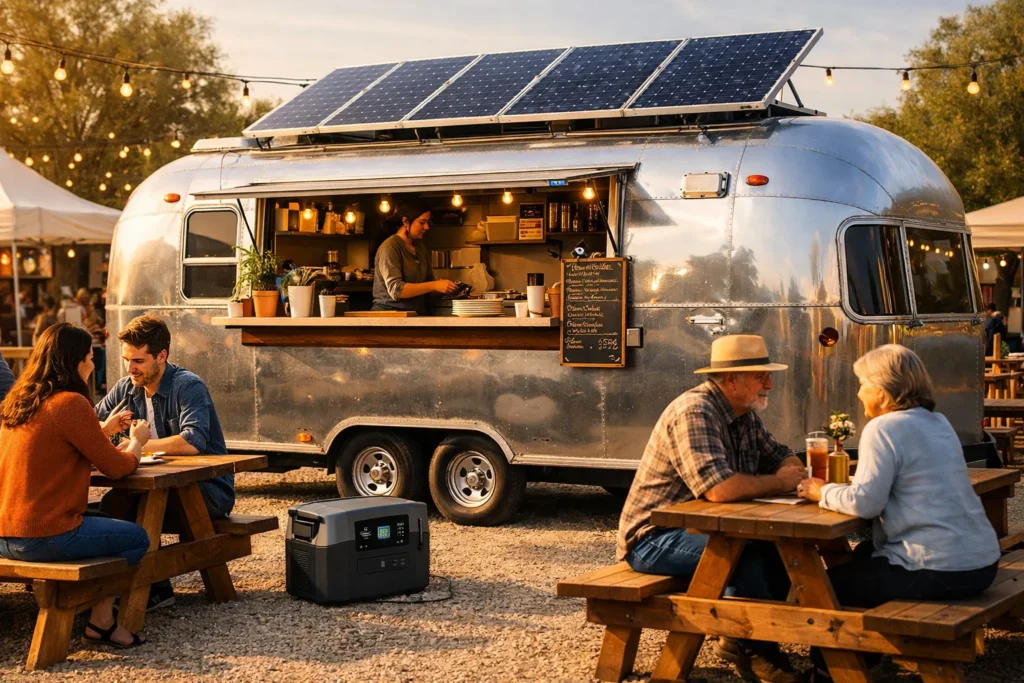
I loaded my vintage Airstream with commercial-grade equipment: industrial refrigerator, LED lighting system, electric grill (1,200 watts), POS register, and prep station with hot plate.
I paired this with a 2,000 Wh power station rated for 2,200 continuous watts (crucial: can handle startup surges from compressor motors).
What happened over a full business day:
The refrigerator cycled normally without any voltage sag. The electric grill heated instantly to serving temperature. LED strips never flickered. The POS system ran flawlessly. During peak rush hour with fridge, lights, and grill running simultaneously, the system delivered every watt required.
Solar panels added roughly 400 Wh back during daylight hours under clear skies. Over eight hours of operation (including meal prep, service, and evening shutdown), the station supplied 1.8 kilowatt-hours of energy without a single emission.
The real result: My customers could actually enjoy their meals in peace. No generator noise. No smell of burning fuel. Just a clean, pleasant dining experience.
And I never refueled or maintained a carburetor again.
CHOOSING THE RIGHT CAPACITY: COMPARISON BY USE CASE
Portable power stations come in three distinct tiers. Each serves different operations.
1,000 Wh Models: Light-Duty Operations
- Perfect for: beverage carts, small snack services, weekend pop-ups
- Can run: phone chargers, mini-fridges, blenders, basic LED lighting
- Won’t run: commercial refrigeration, griddles, or multiple appliances simultaneously
- Weight: 20-30 lbs | Price range: $600-$900 | Runtime: 4-6 hours under mixed loads
- These work great for operators who cook with propane (for heating and cooking) but need electricity only for cooling and electronics.
1,500 Wh Models: Balanced Performance
- Perfect for: small to mid-size food trucks, catering operations, day-long events
- Can run: one commercial refrigerator, basic cooking equipment, lighting, POS system
- Won’t run: multiple high-draw appliances simultaneously at peak power
- Weight: 35-45 lbs | Price range: $1,000-$1,500 | Runtime: 6-10 hours typical operation
- This tier represents the real sweet spot for most food truck owners. Enough power for a complete daily operation without being oversized.
2,000+ Wh Systems: Heavy-Duty Commercial
- Perfect for: full-service kitchens, multiple appliance operations, high-volume catering
- Can run: commercial fridges, fryers, multiple grills, complete lighting, HVAC systems simultaneously
- Benefits: expandable capacity through stacking, integrated solar input for unlimited runtime
- Weight: 50-70 lbs | Price range: $1,800-$2,800 | Runtime: 10+ hours with careful management
- This is what I chose for my operation. The investment pays for itself within 6-12 months through eliminated fuel costs and dramatically improved customer experience.
SPECIFICATIONS THAT ACTUALLY MATTER
When comparing units, focus on these four metrics:
- Pure Sine-Wave Inverter: Your electronics (POS systems, sensitive kitchen equipment) need clean power. Look for “pure sine wave” rating, not modified sine wave.
- LiFePO4 Battery Chemistry: This technology delivers 2,000-3,000+ charge cycles (vs. 500-1,000 for standard lithium). That’s 5-10 years of daily use before capacity drops.
- Solar Input Capacity: Higher solar input (measured in watts) means faster recharging during daylight. 400-500W input lets you recharge while operating.
- Port Configuration: Need USB for phones? USB-C for laptops? Multiple AC outlets? Check this before buying.
THE FINANCIAL REALITY: COST-BENEFIT ANALYSIS
Initial investment: $1,500-$2,500 for commercial-grade system
Daily fuel costs (traditional generator): $40-$60 (propane or gas)
Daily power station operating cost: $0 after purchase
Monthly savings: $1,200-$1,800
Payback period: 1-2 months
This calculation doesn’t even include maintenance savings. Gas generators require regular servicing, spark plug replacements, and eventual overhauls. Portable power stations? Charge them and they work.
Over five years of operation, a food truck owner switching to portable power saves $30,000-$50,000 while improving customer experience and eliminating environmental impact.
COMPARISON TABLE: POPULAR SYSTEMS FOR FOOD TRUCKS
| System | Capacity | Output | Weight | Cost | Best For |
|---|---|---|---|---|---|
| EcoFlow RIVER 2 Pro | 768 Wh | 800W | 22 lbs | $799 | Beverage/snack carts |
| EcoFlow DELTA 2 | 1,024 Wh | 1,800W | 28 lbs | $1,099 | Small food trucks |
| Jackery Explorer 1500 | 1,536 Wh | 1,800W | 44 lbs | $1,399 | Balanced operations |
| EcoFlow DELTA Pro | 3,600 Wh | 3,600W | 99 lbs | $2,799 | Commercial kitchens |
| Bluetti AC500 | 5,000 Wh | 5,000W | 62 lbs | $3,499 | Multi-unit operations |
CRITICAL FEATURES YOU ACTUALLY NEED
Smart Battery Management: Apps showing real-time watt-hours, charge rates, and temperature prevent surprises during service.
Multiple Charging Options: AC wall outlet + solar + car DC charging gives flexibility wherever you operate.
Expandable Architecture: Systems that stack or accept additional battery modules grow with your business without replacement costs.
Weather Protection: IP65+ rating means your power system survives rain, salt spray, and outdoor conditions.
MAINTENANCE: ACTUALLY SIMPLE
Unlike generators, portable power station maintenance takes minutes:
Clean terminals monthly with isopropyl alcohol to prevent corrosion. Perform a complete discharge-recharge cycle quarterly to maintain cell balance. Keep firmware updated through the manufacturer’s app (most units support this). Store in a cool, dry space when not operating.
That’s it. No oil changes. No filter replacements, and no seasonal winterization.
FAQ: REAL QUESTIONS FOOD TRUCK OWNERS ASK
Q: Can portable power stations actually run refrigeration equipment?
A: Absolutely. Commercial compressors require startup surges of 3-5x running watts, but mid-to-high capacity units (1,500+ Wh) handle this easily. LiFePO4 systems provide the clean power refrigeration needs.
Q: What happens when the sun isn’t shining?
A: The battery kicks in. Solar recharges during daylight; battery runs your equipment anytime. Most users pair multiple solar panels with battery storage for continuous operation.
Q: Can I use the same system for both my food truck and backup home power?
A: Yes. Portable units are genuinely portable. Some owners use them seasonally for food truck operations, then relocate for RV travel or emergency home backup.
Q: How long before the battery stops holding charge?
A: LiFePO4 cells last 10+ years with normal use (daily charge-discharge cycles). They drop to 80% capacity after 2,000-3,000 cycles, but continue working reliably.
Q: Do I need solar panels, or can I just plug into wall outlets?
A: Both work. Wall outlets recharge quickly (2-4 hours) but cost money. Solar recharges slowly (8-12 hours) but costs nothing. Many owners use wall outlets for quick turnarounds and solar for all-day operation.
Q: What’s the difference between starting watts and running watts?
A: Running watts: continuous power your equipment needs. Starting watts: brief surge when motors first engage (usually 2-3x higher). Always check both specs when matching systems to appliances.
THE BIGGER PICTURE: WHY THIS MATTERS
Your food truck isn’t just a business. It’s your independence. It’s your ability to operate anywhere, anytime, without worrying about fuel supply, noise complaints, or environmental regulations.
Portable power stations don’t just solve a technical problem. They fundamentally change what’s possible for mobile food operations. Food truck owners eliminate the noise that keeps customers away. They remove the emissions that regulators restrict. They cut fuel costs that squeeze profit margins.
this 1 device lets you focus on what actually matters: serving great food to people who genuinely want to be there.
I tested this in real conditions with real equipment. The results speak for themselves.
CHOOSING YOUR SYSTEM: DECISION FRAMEWORK
- List every appliance you’ll run and note its wattage (check equipment nameplates)
- Add startup surge capacity (multiply the largest motor by 3)
- Add 20% safety margin to your total
- Match this number to capacity tier above
- Consider scalability: Will your business grow? Buy a system that can expand
FINAL THOUGHTS
The food truck industry is evolving. The old generation relied on loud, dirty, expensive generators. The next generation runs clean, silent, intelligent power systems.
You can either follow the old model and hope regulation changes. Or you can lead your market, deliver a better customer experience, and keep more profits.
The choice is yours. The technology is ready.