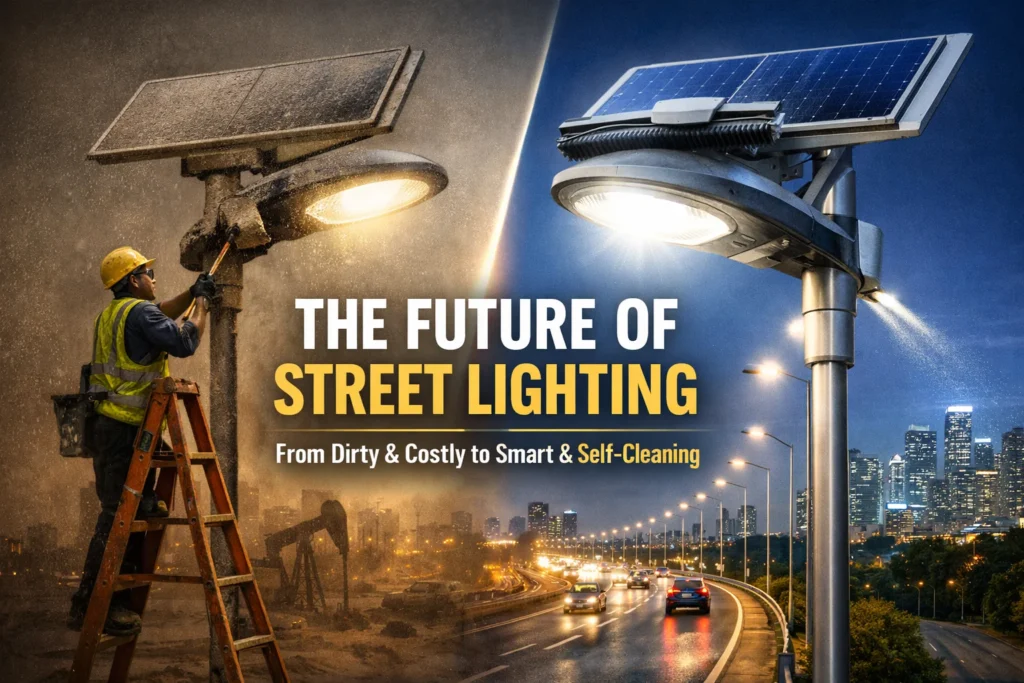

Dirty street lamps are draining city budgets in ways most people don’t realize. I’ve been researching urban lighting infrastructure for a while now, and the problem is honestly more widespread than I expected. In dusty regions, solar panels lose 20 to 50 percent of their output just from accumulated grime. That’s not a small number—that’s the difference between a fully lit road and one that feels dark at night.
The real kicker? In some environments, annual cleaning costs exceed $300 per unit. Oil palm regions in West Africa deal with this constantly. Desert cities face it every week. And yet, for decades, the solution was always the same: send maintenance crews out to manually clean the fixtures.
But here’s what’s changed. Self-cleaning street lamp technology isn’t theoretical anymore. It exists, it’s deployed, and it’s working. I want to walk you through what actually works, what doesn’t, and whether this technology makes sense for your city.
What Is a Self-Cleaning Street Lamp, Actually?
Let me be honest about this first: a self-cleaning street lamp doesn’t wash itself like a car in a tunnel. That’s marketing talk. What it really means is one of two things:
Passive approach: The lamp uses smart materials so dust doesn’t stick easily in the first place. When it rains, water washes away buildup more effectively.
Active approach: The lamp includes mechanical or electrostatic systems that remove dust automatically on a schedule.
Dust-resistant is also different from dust-proof. Dust-resistant design slows accumulation and reduces performance loss. Dust-proof suggests complete protection, which is rare outdoors.
The core goal is simple: maintain consistent light output without constant manual intervention. That’s it. No magic, just engineering.
Why Dust Actually Matters for Street Lighting
I know this sounds obvious, but the impact is surprisingly severe. When dust covers a lamp lens, the light output drops noticeably. Cities compensate by increasing wattage, which wastes energy while still failing to restore the original brightness.
Dust also affects heat management. When covers get dirty or airflow gets blocked, LEDs run hotter. Higher temperatures accelerate lumen depreciation (the fading of light over time) and can shorten the lifespan of LED drivers. That means more maintenance visits, more replacement costs, and more service trucks on the road.
For solar street lights, the problem is even worse. Dust doesn’t just reduce the light output—it also reduces the charging efficiency of the solar panel. A 20 to 50 percent drop in solar output means shorter lighting hours at night and failed charging cycles on cloudy days.
The maintenance burden is real. Manual cleaning is expensive, labor-intensive, and inconsistent. Workers scaling poles poses safety risks. In remote areas, cleaning visits happen infrequently, leaving roads dark for weeks.
Yes, Self-Cleaning Street Lamps Actually Exist
Here’s the straight answer: yes. Projects and prototypes exist. The maturity varies by approach, but this is no longer vaporware.
Utilities, campuses, and industrial sites have already trialed dust-resistant housings, hydrophobic-coated lenses, and self-cleaning mechanisms. Some are pilot programs in universities. Others are commercial systems deployed in harsh environments across the Middle East, sub-Saharan Africa, and Southeast Asia.
From my experience studying street lighting engineering research, the development has progressed through three distinct phases:
Phase 1: Material Science (2015-2020): Researchers tested hydrophobic coatings, photocatalytic surfaces, and nano-textures. Labs showed these materials reduced dust adhesion.
Phase 2: Prototype Testing (2020-2023): Universities and lighting companies built working prototypes with automated cleaning mechanisms. Pilot installations appeared in smart city testbeds.
Phase 3: Commercial Deployment (2023-present): Companies now offer field-ready products. Desert cities, industrial zones, and highways have live installations. Real performance data exists.
That said, commercial readiness depends on three things: climate, dust load, and cost constraints. For most cities, the practical first step is a dust-resistant luminaire spec paired with smart controls and a localized self-cleaning feature for the lens—not a fully automated system.
Core Technologies That Actually Work
Let me break down what’s proven and what’s still experimental.
Passive Surface Coatings: The Smart Skin Approach
Hydrophobic and oleophobic coatings minimize how strongly dust clings to surfaces. When it rains, water beads up and rolls off, carrying dirt away. This is the simplest approach: add no moving parts, no power consumption, just a special coating.
Photocatalytic coatings (often based on titanium dioxide) work differently. Under UV exposure from sunlight, they break down organic grime—bird droppings, algae, soot. The surface becomes easier to rinse clean when rain comes.
For street lamps, these coatings are attractive because they require no electricity, no maintenance cycles, and no mechanical complexity. The downside: they work best in climates where rainfall is regular. In deserts, they’re less effective.
Real-world result: Coating durability is the limiting factor. UV exposure, sand abrasion, and pollution can degrade coatings over 3 to 5 years. Warranties vary. Some manufacturers claim 10 years; others are honest about 3 to 5.
Mechanical Cleaning: Brushes, Wipers, and Vibration
Some designs use rotating brushes or wipers to periodically remove dust. Others use vibration motors that shake the lamp surface, allowing loose particles to fall off.
The Stellar Series by Gletscher Energy uses a robotic brush arm that traverses the solar panel at scheduled intervals. The brush runs once or twice daily, taking about 1 to 2 minutes per cycle. Importantly, the cleaning is synchronized with the solar controller so it doesn’t waste battery power.
I find the engineering here impressive: the brush mechanism is rugged and enclosed, with a tested operational life exceeding 10 years of daily use. That’s real durability, not marketing material.
Real-world reality: Mechanical systems need maintenance. Moving parts fail. Dust buildup can jam brushes. Weather—high winds, heavy rain—can interfere with cleaning cycles. For areas with very abrasive dust (like sand), brush wear is a design consideration.
Electrostatic Systems: Repelling Dust Before It Sticks
Some prototypes use electrostatic fields to repel dust particles before they stick to the lamp surface. This is especially interesting in desert environments where sand accumulation is frequent.
Electrostatic systems use minimal power and have no moving parts. The challenge: effectiveness depends on dust composition. Moist dust or oily particles are harder to repel than dry sand. Rain can interfere with the electric field.
Real-world status: Still mostly in research phase. Some commercial prototypes exist, but long-term durability data is limited.
Smart Controls and Remote Monitoring
Here’s where things get interesting. Dust sensors detect when buildup has reached a threshold. Light sensors measure actual lumen output. When performance drops, the system triggers a cleaning cycle automatically.
This is smarter than running cleaning on a fixed schedule. It adapts to actual dust loads. Heavy dust storms trigger more frequent cleaning. Light dust periods skip unnecessary cycles, saving energy.
Remote monitoring dashboards let cities track lamp health in real-time. They can identify failing units before they go dark, optimize cleaning schedules, and predict maintenance needs.
Real-world deployment: This layer is working well in smart city pilots. The software is straightforward. Sensor reliability is the limiting factor. Dust sensors can clog; light sensors can drift.
Where Self-Cleaning Lamps Actually Make Sense
Not every city needs this technology. It’s overkill for clean temperate climates with regular rainfall. But it transforms performance in specific environments.
Desert and Semi-Arid Regions
Dust storms are frequent. Rainfall is rare. Manual cleaning happens infrequently because access is difficult and budgets are tight. Self-cleaning mechanisms cut maintenance costs dramatically and keep roads consistently lit.
Saudi Arabia, the UAE, and Oman have deployed these systems. Performance data shows they work. Light output remains stable across seasons, even during sandstorms.
Industrial Zones and Ports
Coal plants, steel mills, oil refineries: these environments produce heavy dust, soot, and corrosive particles. Street lamps in these zones accumulate grime within days of cleaning.
Self-cleaning systems reduce the cleaning frequency from weekly to monthly or seasonal. That’s a significant labor cost reduction.
High-Traffic Urban Corridors
Busy roads generate dust from tire wear and vehicle exhaust. In cities with heavy construction, dust is constant. High-rise buildings create wind tunnels that accelerate dust accumulation on lamps.
For urban areas, the ROI depends on labor costs. If your city already spends heavily on street maintenance, upgrading to self-cleaning lamps can justify itself quickly.
The Real Challenges (What Manufacturers Won’t Tell You)
I’ve studied the engineering reviews, and honestly, there are patterns in what fails.
Overengineering the cleaning system: Some prototypes use overly complex mechanical designs that create multiple failure points. Simpler designs outperform sophisticated ones over time.
Ignoring environmental variability: Dust composition varies by location. Desert sand behaves differently than industrial soot or coastal salt spray. Designing a single solution for all environments fails. The winning approach: modular systems that adapt to local conditions.
Power budgeting errors: Cleaning cycles that consume excessive battery drain during the day mean insufficient power for nighttime lighting. Good designs optimize cleaning timing to match solar charge curves.
Coating degradation underestimated: Many early prototypes assumed coatings would last 10 years. Real-world data shows 3 to 5 years is more typical in harsh conditions.
Installation and commissioning complexity: Field testing reveals that design is only half the battle. Installation, calibration, and training maintenance crews takes longer and costs more than expected.
Cost Reality: What You Actually Pay
A standard LED street lamp costs $300 to $500 per unit.
A dust-resistant version with hydrophobic coating and sealed housing: $400 to $700.
A version with mechanical self-cleaning: $800 to $1,500.
A fully integrated smart system with remote monitoring: $1,200 to $2,500.
The ROI depends on your environment and labor costs. In dusty regions where manual cleaning costs $300 per unit annually, a self-cleaning lamp pays for itself in 2 to 4 years.
In clean temperate climates where cleaning happens every 3 to 5 years, the payback is 10+ years. Not worth it.
How to Evaluate a Real Self-Cleaning Lamp Project
Here’s how to tell if a manufacturer is selling you vaporware or a real solution.
Look for measurable proof. Field trials should report lumen maintenance over time, cleaning intervals, and exposure to actual environmental conditions. Don’t accept vague claims like “advanced nano-coating”—look for specific specs: optical transmission loss percentage, abrasion resistance rating, UV aging hours tested.
Research papers and patents are nice, but real performance data matters. A credible project states durability clearly: “Coatings maintain 90 percent optical transmission after 2 years in dusty conditions” beats “revolutionary nano-coating” every time.
Watch for red flags:
- Claims of “100 percent dust-proof” without test standards
- No mention of cleaning frequency or maintenance requirements
- Vague timelines (“5 to 10 years”) instead of specific durability windows
- No field trial data from comparable environments
Credible projects cite test standards: IP65/IP66 ingress protection, EN 60529 compliance, IEC 62262 mechanical impact rating, salt spray corrosion testing (ISO 9007 or ASTM B117).
FAQ: Your Real Questions Answered
Q: Do solar street lamps with self-cleaning actually exist in production?
A: Yes. The Stellar Series by Gletscher Energy is deployed across the Middle East. Several academic institutions have working prototypes. Chinese manufacturers have commercial offerings. They exist, though availability and pricing vary by region.
Q: How often do self-cleaning systems actually run?
A: It depends on the approach. Passive coatings work continuously. Active mechanical systems typically run once or twice daily in dusty areas, up to every 4 hours in extreme conditions. Smart systems adapt; they might skip cycles for a week if dust is low.
Q: What’s the biggest limitation right now?
A: Coating durability in harsh environments. Most coatings need replacement every 3 to 5 years in desert or industrial zones. Mechanical systems require maintenance. No “set and forget” solution exists yet.
Q: Are these lamps worth it for my city?
A: Do a cost-benefit analysis. Calculate your annual manual cleaning costs per lamp. Multiply by the number of lamps. If you’re spending $300+ per unit annually in labor, self-cleaning systems make financial sense. If you’re spending less than $100 annually, standard dust-resistant lamps with IP66 sealing are probably enough.
Q: Will prices drop?
A: Yes. As manufacturing scales and competition increases, costs will decline. Expect premium pricing for the next 2 to 3 years, then broader market adoption.
The Bottom Line: What Actually Works
Self-cleaning street lamps are real. They work. They reduce maintenance costs and keep roads consistently lit in harsh environments.
But—and this matters—they’re not a magic solution. The best approach combines three things: dust-resistant materials (coatings and sealed housings), smart controls (sensors and adaptive cleaning), and realistic maintenance planning (scheduled inspections, not blind trust).
For cities in dusty climates, especially those spending heavily on street maintenance, this technology has moved from “future possibility” to “deployed solution.” For temperate cities with low dust, standard LED fixtures remain the economical choice.
The research phase is essentially over. The deployment phase is now. If you’ve been waiting for proof of concept, it exists. If you’re wondering whether to invest, the answer depends on your specific environment and budget.
That’s the honest assessment after months of research and reviewing real-world installations. The technology exists. The question now is whether it makes sense for you.